

People who have never smoked are currently excluded from England's routine lung cancer screening programme. But could family history help identify some who might benefit?
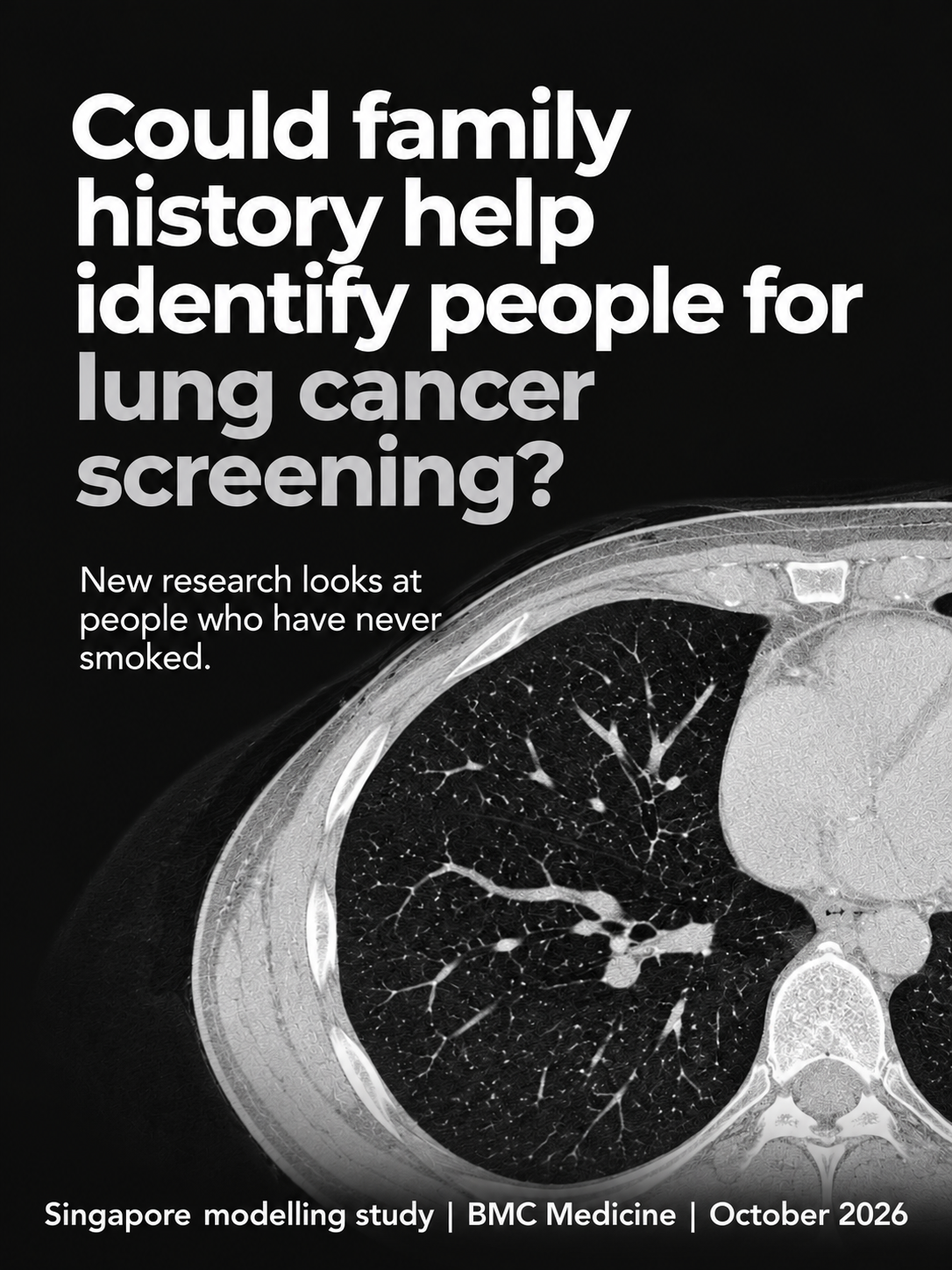
New research from Singapore, published in BMC Medicine on 27 October 2026, has examined whether lung cancer screening could be better targeted using individual risk rather than relying on age and smoking history alone.
What did the researchers find?
Researchers at the National University of Singapore used computer modelling to compare different approaches to lung cancer screening using low-dose CT scans.
Importantly, the study included people who had never smoked but had a family history of lung cancer.
The researchers compared different starting ages, screening intervals and levels of risk to see which approaches might offer the greatest health benefits at a reasonable cost.
Their findings suggest that risk-based screening could help identify some people who have never smoked who might benefit from regular lung scans, while making better use of healthcare resources.
However, the most cost-effective screening approach differed according to age and sex.
Why does this matter in the UK?
Lung cancer can affect anyone, regardless of smoking history.
In England, the national lung cancer screening programme currently focuses on people aged 55 to 74 who have a history of smoking and meet the programme's risk criteria.
That means people who have never smoked are not routinely invited, even though some may have other risk factors, including a family history of lung cancer.
Research like this raises an important question: could screening eligibility eventually take more risk factors into account?
What happens next?
This was a modelling study, not a clinical trial. It did not demonstrate that screening people who have never smoked reduces lung cancer deaths.
The findings are based on Singapore's population and healthcare system, so they cannot be applied directly to the NHS.
Further research is needed to understand who could benefit from screening, how frequently scans should be offered and how to balance the potential benefits against unnecessary investigations and other harms.
But the study adds to growing research into how lung cancer screening might reach people whose risk isn't captured by smoking history alone.
Read the research
Juang YR et al. Optimizing precision lung cancer screening using willingness-to-pay–anchored risk eligibility thresholds.
BMC Medicine, published 27 October 2026.
