

Could hotter summers increase lung cancer risk inside our homes?
Radon is a naturally occurring radioactive gas that can cause lung cancer, including in people who have never smoked. New research suggests that hotter summers and changes to how we cool our homes could increase exposure to this invisible risk.
We often think about air pollution as something outside our homes. But radon comes naturally from the ground and can enter buildings, sometimes building up to harmful levels.
A new study published in Communications Sustainability, a Nature Portfolio journal, examined how climate change could affect our exposure to radon indoors.
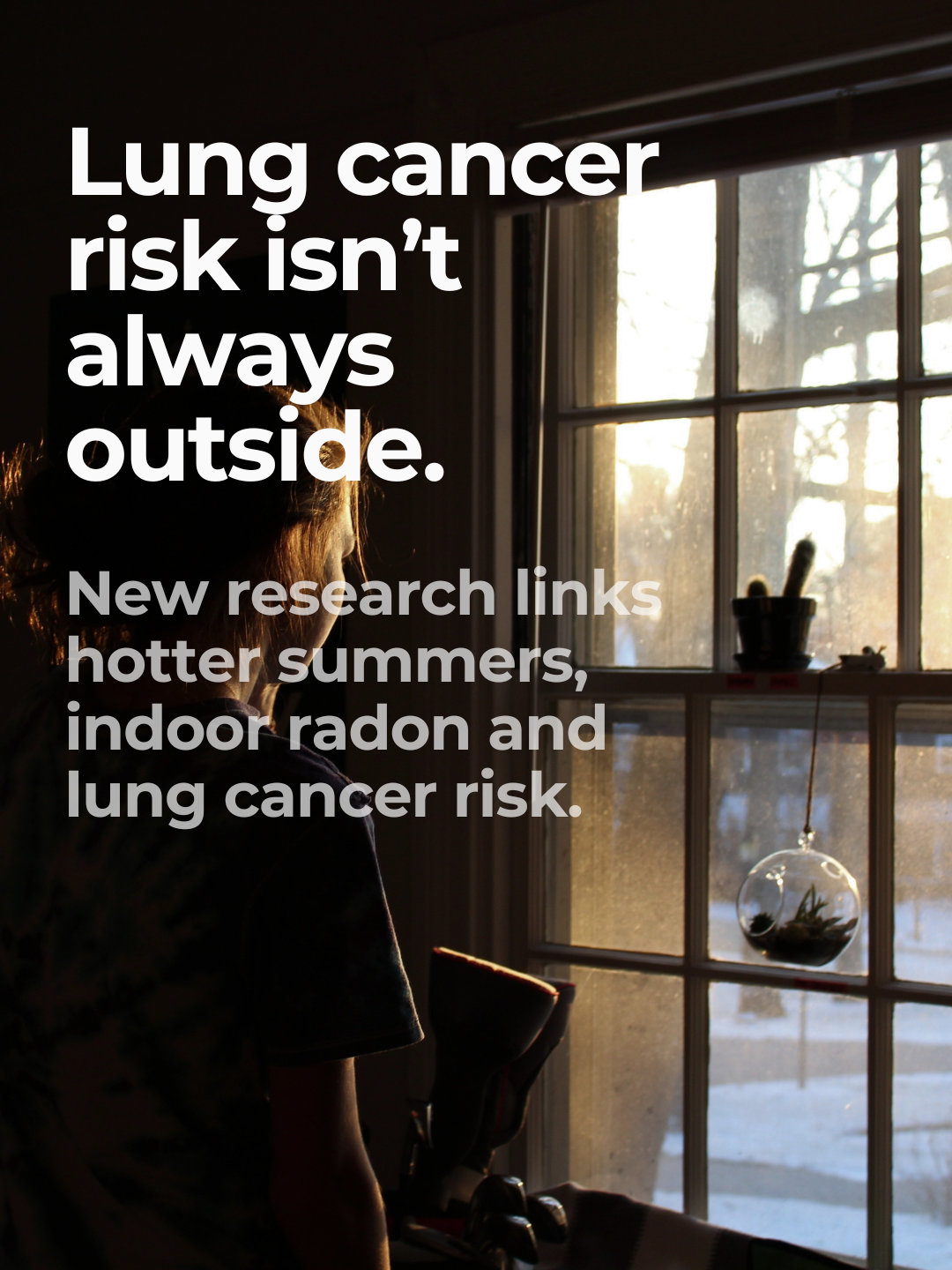
What did the researchers find?
Researchers from the University of California, Irvine, and the Italian National Institute of Health examined possible changes in how people use their homes during hotter weather.
They modelled scenarios involving more air conditioning, spending longer indoors and moving into cooler basement rooms.
Their findings suggest that these changes could increase exposure to radon, particularly in homes where ventilation is inadequate.
In one hypothetical scenario, involving increased air conditioning and more time spent in basements, the researchers estimated 42 additional lung cancer deaths per 10,000 people by age 85 in a population model combining France, Germany and Italy, compared with their baseline scenario.
This is a modelled estimate, not a prediction of actual deaths. The research did not directly examine UK households.
Why does radon matter for lung cancer?
Radon is an established cause of lung cancer, regardless of smoking history.
It is produced naturally by radioactive materials in rocks and soil. When radon enters buildings, it can accumulate in indoor air.
Long-term exposure can damage cells in the lungs and increase cancer risk.
Unlike traffic pollution or smoke, radon has no colour or smell, so people may be unaware of its presence.
What does this mean for UK homes?
Radon occurs throughout the UK, although levels vary considerably depending on local geology and individual buildings.
The research doesn't mean people should stop using air conditioning or avoid keeping cool during heatwaves. Protecting people from extreme heat remains important.
Instead, the findings highlight the need to consider indoor air quality when improving insulation, ventilation and cooling systems.
For people living in the UK, there is a practical first step: checking whether their home is in an area with higher radon potential.
The official UKradon website, supported by the UK Health Security Agency, provides information about radon, maps and home testing.
Lung cancer isn't only linked to smoking
Understanding environmental causes of lung cancer is especially important for people who have never smoked, who may not consider themselves at risk.
Radon is one of several recognised causes of lung cancer. Research into these risks can help improve prevention and awareness for everyone.
The new study doesn't establish that hotter summers are already causing additional lung cancer diagnoses. But it identifies another reason to take the air inside our homes seriously.
Read the research
Lee H, Loret N, Antignani S, Bochicchio F and Richardson DB.
Climate change exacerbates residential radon exposure and lung cancer risk.
Communications Sustainability, October 2026.
