Researchers have found two proteins in the blood that were linked to a higher chance of developing lung cancer in people who have never smoked, up to five years before diagnosis.
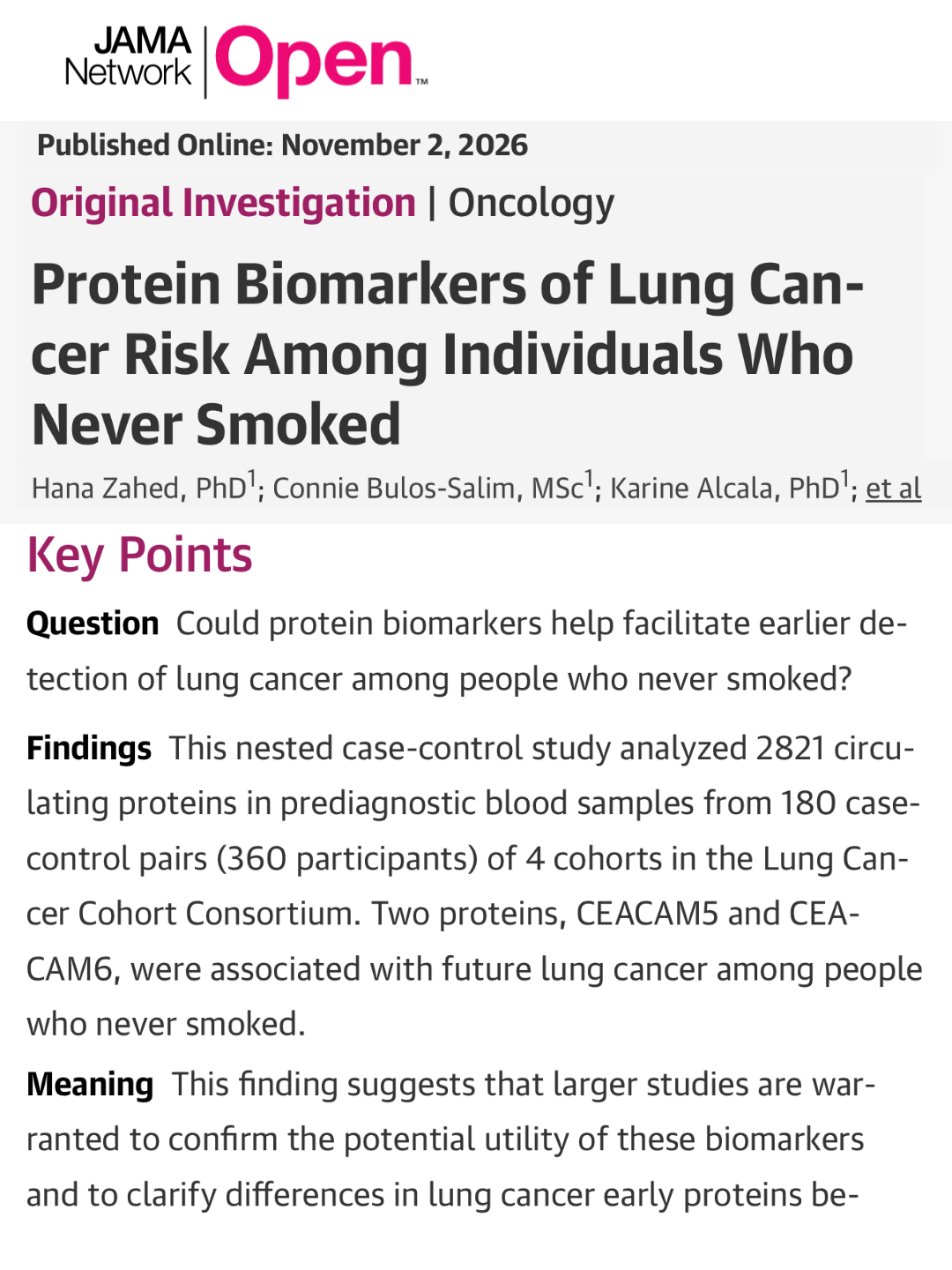
The study comes from the World Health Organization’s International Agency for Research on Cancer (IARC) and was published in JAMA Network Open on 2 November 2026. It is early research and not a blood test for lung cancer. But it is one of very few studies to look specifically at how we might one day identify people who have never smoked who are at higher risk of lung cancer.
Why people who have never smoked are left out of lung cancer screening
Anyone with lungs can get lung cancer. Around 15% of people diagnosed with lung cancer in the UK have never smoked. If it were counted as a separate disease, lung cancer in people who have never smoked would be the eighth most common cancer in the UK.
England’s lung cancer screening programme uses smoking history to decide who is invited for a scan. People who have never smoked are not eligible, and there is currently no proven way to tell which people in this group are at higher risk. Finding reliable signs of risk is one of the first steps towards changing that.
What the researchers did
The team used blood samples that had been collected and stored years earlier as part of four large health studies in the US and China. All the participants had never smoked.
180 people went on to develop lung cancer within five years of giving a blood sample.
Each was matched with someone of the same age and sex, from the same study, who did not develop lung cancer.
The researchers measured 2,821 different proteins in each sample.
On average, the blood had been taken just under three years before diagnosis.
Two blood proteins stood out: CEACAM5 and CEACAM6
Out of all 2,821 proteins, only two remained linked to lung cancer risk after the researchers applied their strictest statistical checks. They are called CEACAM5 and CEACAM6. CEACAM5 is already well known in cancer care: it is routinely used to check whether bowel cancer has come back in people who have been treated for it.
People with higher levels of these proteins in their blood were more likely to go on to develop lung cancer within five years. For each standard step up in protein level, the odds of lung cancer were around 65% higher for CEACAM5 and around 72% higher for CEACAM6.
The links were still there, although slightly weaker, when the blood had been taken more than two and a half years before diagnosis. The two proteins were only weakly related to each other, which suggests each may add its own information about risk.
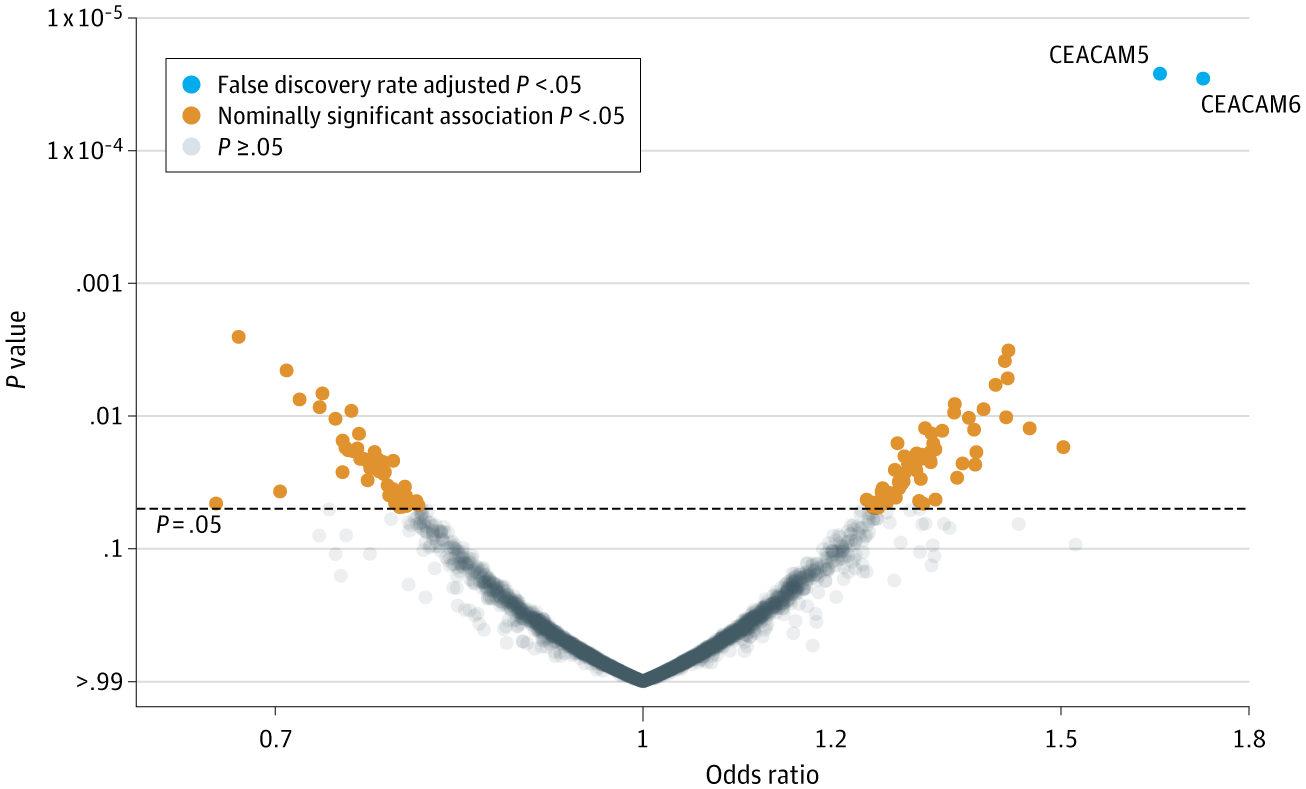
About the graph: each dot is one of the 2,821 proteins tested. The higher a dot sits, the stronger the evidence of a link with lung cancer. Dots to the right were linked to higher risk, and dots to the left to lower risk. Orange dots showed a possible link, but only CEACAM5 and CEACAM6, in blue at the top right, passed the study’s strictest test. Figure: Zahed H et al, JAMA Network Open, 2026, CC BY.
Checking the results in UK Biobank
The researchers then looked at UK Biobank, a large UK health study, using data from almost 50,000 people. Both proteins were again linked to a higher risk of lung cancer within five years.
However, only 16 of the people in this group who developed lung cancer had never smoked, so most of this analysis included people who had smoked. It supports the findings, but cannot confirm them specifically in people who have never smoked.
Smoking-related blood markers did not carry over
The team also tested 36 proteins that earlier research had linked to lung cancer risk in people who smoke. Most showed no link with lung cancer in people who had never smoked. Only four did, including CEACAM5.
This suggests that tools to predict lung cancer risk in people who have never smoked will need to be developed and tested specifically for this group, rather than borrowed from tools designed for people who smoke.
What we still don’t know
The main study was small, with 180 people who developed lung cancer. Most participants were women and most were from China, so the findings need testing in larger and more varied groups, including in the UK.
The researchers did not work out a person’s overall chance of developing lung cancer, or how these proteins might combine with other risk factors such as family history or environmental exposures.
No one has yet tested whether measuring these proteins would lead to earlier diagnosis or save lives.
The researchers say larger studies are needed before these findings could be used to decide who might benefit from lung cancer screening.
Know the symptoms of lung cancer
There is no blood test for lung cancer risk available today. The most important thing anyone can do is know the symptoms and get them checked:
a cough that won’t go away
breathlessness
fatigue
a hoarse or croaky voice
chest, shoulder or back pain
unintentional weight loss
chest infections that keep coming back
coughing up blood
If you have symptoms that don’t go away, speak to your GP, even if you have never smoked. All you need is lungs.
Read the research: Zahed H, Bulos-Salim C, Alcala K, et al. Protein biomarkers of lung cancer risk among individuals who never smoked. JAMA Network Open. 2026;9(11):e2641494. doi:10.1001/jamanetworkopen.2026.41494