

Why is it so hard to predict lung cancer in people who have never smoked?
A new UK-led research review has looked at the tools developed to help identify lung cancer earlier in people who have never smoked.
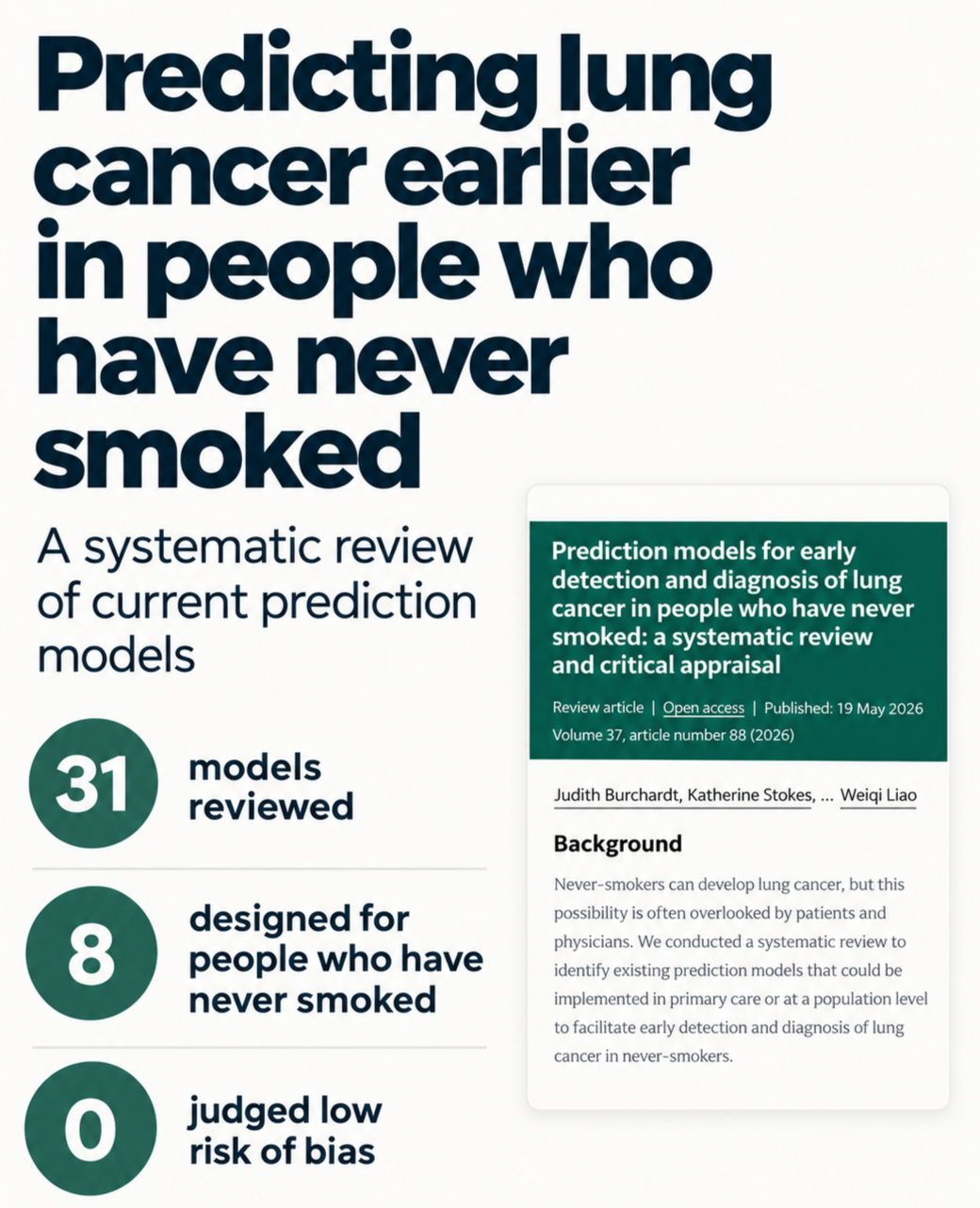
Researchers identified 31 prediction models, including eight developed specifically for people who have never smoked. However, none of those eight was judged to have a low risk of bias, meaning there are concerns about how reliable their findings may be.
The results highlight an important gap in research into earlier lung cancer diagnosis.
What is a lung cancer prediction model?
A prediction model is a tool that uses information such as age, symptoms and medical history to estimate someone’s risk of developing lung cancer or having the disease.
These tools could potentially help GPs recognise when further investigations are needed.
But for people who have never smoked, the evidence is still limited.
What did the researchers find?
The review, published in Cancer Causes & Control in May 2026, examined research from around the world.
It identified:
31 models that could potentially be used in primary care or across the wider population.
8 models developed specifically for people who have never smoked.
0 of those 8 models were judged to have a low risk of bias.
5 models developed using populations with different smoking histories were judged to have a low risk of bias.
This does not mean that all existing prediction tools are ineffective. It means more research and testing are needed before we can be confident about how well they work for people who have never smoked.
Why is this important for earlier diagnosis?
Anyone can develop lung cancer, regardless of smoking history.
But when someone has never smoked, lung cancer may not be considered as a possible explanation for their symptoms.
That can contribute to delays in diagnosis.
Better risk prediction tools could eventually help healthcare professionals recognise lung cancer earlier, including in people who may not traditionally be considered at risk.
The review also raises an important question for UK lung cancer services: how can we improve earlier diagnosis for people who fall outside current screening criteria?
England’s NHS lung cancer screening programme currently focuses on people aged 55 to 74 who have ever smoked and meet the programme’s risk criteria.
What happens next?
The researchers conclude that better-quality studies are needed to develop and assess prediction tools for people who have never smoked.
More reliable evidence could help inform future approaches to risk assessment, earlier diagnosis and lung cancer services.
For All You Need Is Lungs, the message is simple: lung cancer must be considered regardless of someone’s smoking history.
Read the research
Judith Burchardt and colleagues. Published in Cancer Causes & Control, 19 May 2026.
